.jpg)
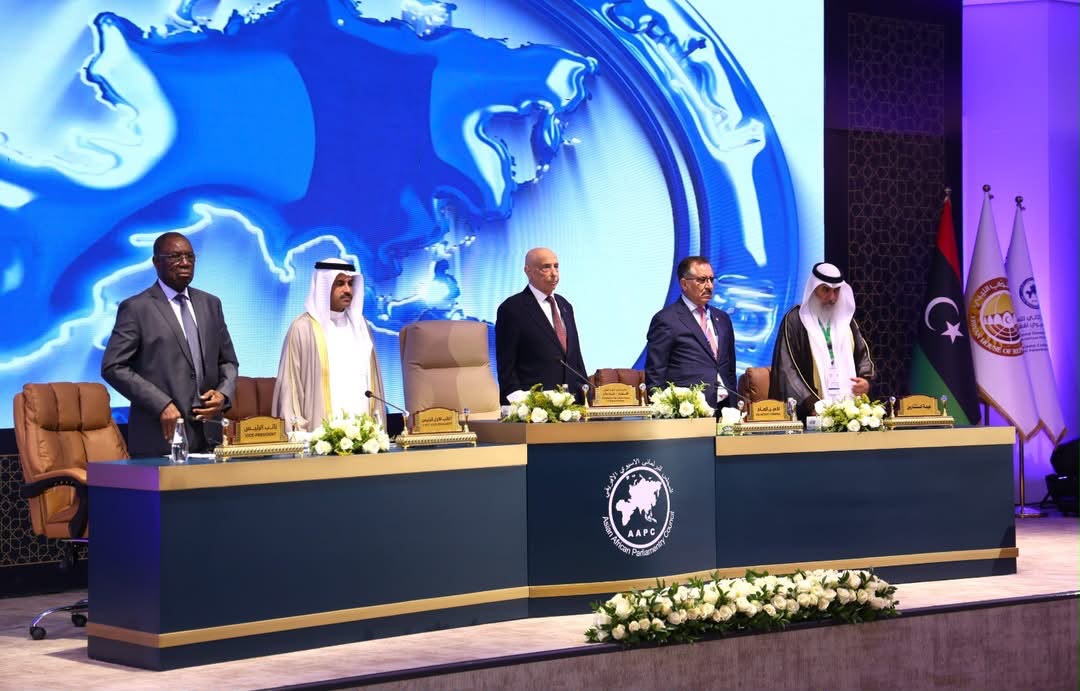
Mr. Saud Rashid AlHujailan, President of the International Federation of Asian and African Trade Unions (IFAATU) and Acting President of the Asian-African Parliamentary Council (AAPC), chaired a meeting of the Asian-African Parliamentary Council on 22 October 2025, at the headquarters of the Libyan House of Representatives in Benghazi.
The meeting was attended by the Secretary-General, Deputy Secretary-General, directors of the Council’s departments, the Parliamentary Affairs Adviser, and several Council officials, including:
* Mr. Fayez Al-Shawabkeh – Secretary-General.
* Mr. Abdullah Al-Masri Al-Fadhil – Deputy Secretary-General.
* Mr. Idris Al-Farjani – Director of the Coordination Department.
* Mr. Khaled Al-Tayeb – Director of Protocol, Ceremonies and International Relations.
* Mr. Ahmed Hashash – Parliamentary Affairs Adviser.
* Mr. Ahmed Mubarak Al-Dukhnan – Director of the Office of the First Deputy.
Meeting Agenda
The meeting discussed a number of priority issues related to developing the Council’s work and strengthening its institutional performance. The participants reviewed the Council’s work plan, identified its priorities for the coming period, and discussed the activities and programmes scheduled for implementation.
They also examined mechanisms for activating the roles of the various departments and strengthening coordination and integration among them, with the aim of improving performance efficiency and achieving the Council’s objectives.
The meeting further addressed the preparations required for the next meeting of the Executive Council, including organisational, administrative and technical requirements, as well as completing the necessary arrangements to ensure proper preparation and organisation.
Meeting Outcomes and Recommendations
As part of efforts to develop working mechanisms and enhance institutional effectiveness, the meeting emphasised several priorities and executive directions, most notably:
First: Following Up on the Implementation of the Council’s Work Plan
Reviewing the Council’s work plan, identifying priorities, programmes and activities for the coming period, establishing a clear implementation timetable, assigning responsibilities to the relevant departments, and periodically monitoring progress.
Second: Activating the Agreement with the Parliamentary Assembly of the Mediterranean
Giving special attention to the agreement concluded between the Asian-African Parliamentary Council and the Parliamentary Assembly of the Mediterranean, following up on its provisions and working towards its activation and implementation.
This includes establishing practical mechanisms for joint cooperation and coordination, identifying areas of partnership and programmes and activities of mutual interest, translating the agreement’s objectives into tangible implementation steps, and strengthening institutional and parliamentary cooperation between the two sides.
Third: Strengthening International Parliamentary Relations and Cooperation
Expanding the network of relations and communication with regional and international parliaments and parliamentary organisations, activating channels of joint cooperation, and exploring new partnership and coordination opportunities to strengthen the Council’s presence and active participation in international parliamentary forums.
Fourth: Preparing for the Next Meeting of the Executive Council
Completing the necessary preparations for the next Executive Council meeting, preparing the files and proposed agenda items, and following up on organisational, administrative, technical and protocol-related arrangements in coordination with the relevant departments.
Fifth: Developing Administrative and Institutional Work
Strengthening coordination and communication between the General Secretariat and the various departments, developing working mechanisms, and clearly distributing tasks and responsibilities to accelerate implementation and improve institutional efficiency.
Sixth: Following Up on the Implementation of Decisions and Recommendations
Establishing a periodic follow-up mechanism for implementing the Council’s decisions and recommendations, preparing regular reports outlining implementation stages and completion rates, identifying and addressing obstacles and challenges, and submitting the results to the Council Presidency for appropriate action.
Emphasis on Implementation and Follow-up
At the conclusion of the meeting, Mr. Saud Rashid AlHujailan stressed the importance of intensifying efforts during the coming period and moving from the planning stage to actual implementation.
He emphasised the need to give priority to key files, particularly the activation of parliamentary agreements and partnerships, following up on the implementation of the agreement with the Parliamentary Assembly of the Mediterranean, and completing preparations for the next meeting of the Executive Council.
He also highlighted the importance of teamwork, strengthening coordination and integration between the General Secretariat and the various departments, and unifying efforts to ensure that plans and programmes are implemented in accordance with the established objectives.
This meeting comes within the framework of ongoing efforts to develop the institutional work of the Asian-African Parliamentary Council (AAPC), strengthen its role in consolidating parliamentary relations between Asian and African countries, and expand areas of cooperation and partnership with regional and international parliamentary organisations and federations, thereby enhancing the Council’s standing and presence in international parliamentary forums.
Troisième : Version française
Saud Rashid AlHujailan préside une réunion du Conseil parlementaire Asie-Afrique (AAPC) à Benghazi et examine les priorités de travail ainsi que le renforcement des partenariats internationaux
M. Saud Rashid AlHujailan, président de la Fédération internationale des syndicats d’Asie et d’Afrique (IFAATU) et président par intérim du Conseil parlementaire Asie-Afrique (AAPC), a présidé, le 22 octobre 2025, une réunion du Conseil parlementaire Asie-Afrique au siège de la Chambre des représentants libyenne, dans la ville de Benghazi.
La réunion s’est tenue en présence du secrétaire général, du secrétaire général adjoint, des directeurs des différents départements du Conseil, du conseiller aux affaires parlementaires ainsi que de plusieurs responsables, notamment :
* M. Fayez Al-Chawabkeh – Secrétaire général.
* M. Abdullah Al-Masri Al-Fadhil – Secrétaire général adjoint.
* M. Idris Al-Farjani – Directeur du département de coordination.
* M. Khaled Al-Tayeb – Directeur du département du protocole, des cérémonies et des relations internationales.
* M. Ahmed Hashash – Conseiller aux affaires parlementaires.
* M. Ahmed Mubarak Al-Dukhnan – Directeur du cabinet du premier vice-président.